As an Amazon Associate I earn from qualifying purchases. (Also includes AliExpress affiliate links.)
QNAP TS-H1077AFU vs QNAP TS-H977XU-RP
The quick verdict
- Lower power drawQNAP TS-H977XU-RPdraws 76.4 W, 126.8 W less than the TS-H1077AFU
- Spec leadeach leads on 4 of 8 differing specs
- Best forTS-H1077AFU for creators moving large video files fast
Rankings and scores come from the specs alone and are not affected by affiliate commissions.
Spec ruler
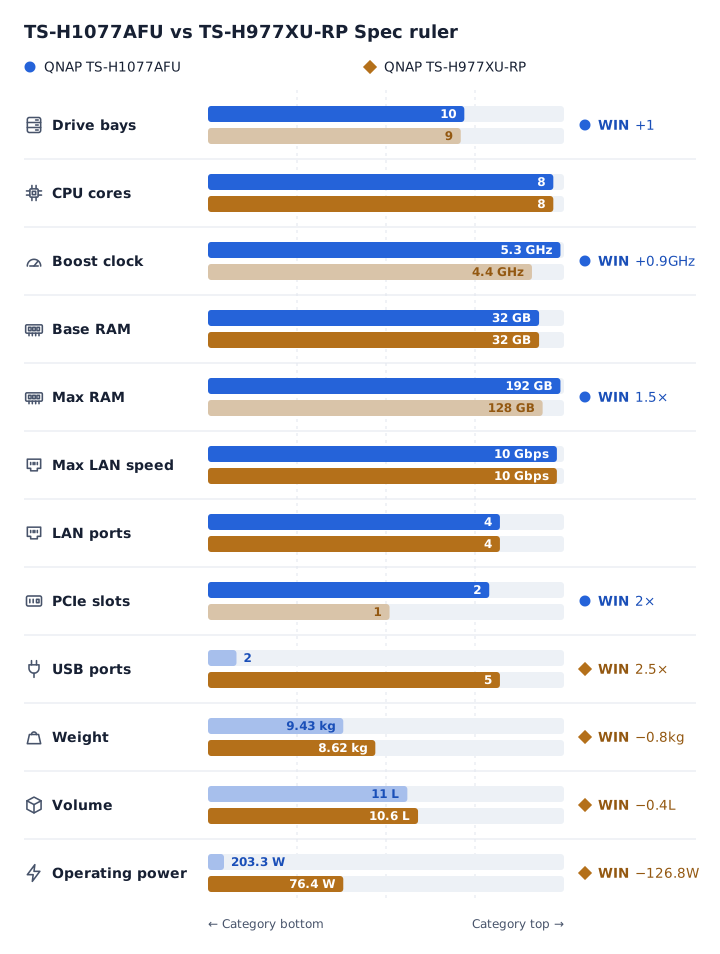
In short
Bottom line. Of the 8 specs that differ, the QNAP TS-H1077AFU leads on 4 (drive bays, boost clock, max RAM, and 1 more) and the QNAP TS-H977XU-RP on 4 (USB ports, weight, volume, and 1 more). On our 10GbE video editing index, the TS-H1077AFU scores 85/100 against 84/100.
Using the 12 specs published on QNAP's official hardware specification pages, here is how the QNAP TS-H1077AFU and QNAP TS-H977XU-RP compare. Drive bays: the TS-H1077AFU at 10 bays versus 9 bays for the TS-H977XU-RP, 1 bay more. Among 219 QNAP models, the TS-H1077AFU ranks in the top 28% and the TS-H977XU-RP in the top 29%. The TS-H1077AFU leads on boost clock, 5.3 GHz to 4.4 GHz, 1.2x. Among 201 QNAP models, the TS-H1077AFU ranks in the top 1% and the TS-H977XU-RP in the top 9%. On max RAM, the TS-H1077AFU posts 192 GB and the TS-H977XU-RP 128 GB, a gap of 64 GB. Among 219 QNAP models, the TS-H1077AFU ranks in the top 1% and the TS-H977XU-RP in the top 6%. PCIe slots: the TS-H1077AFU at 2 slots versus 1 slot for the TS-H977XU-RP, 1 slot more (2.0x). Among 146 QNAP models, the TS-H1077AFU ranks in the top 21% and the TS-H977XU-RP in the top 49%.
Key differences 3
Operating powerTS-H977XU-RP leads
- TS-H977XU-RP 76.4 W vs the TS-H1077AFU at 203.3 W
- the TS-H977XU-RP: 126.9 W less power
- among 208 QNAP models: TS-H977XU-RP in the bottom 39%, TS-H1077AFU in the bottom 5%
about 1111.1 kWh less per year if left on 24/7
USB portsTS-H977XU-RP leads
- TS-H977XU-RP 5 ports vs the TS-H1077AFU at 2 ports
- the TS-H977XU-RP has 2.5x the USB ports
- among 219 QNAP models: TS-H977XU-RP in the top 18%, TS-H1077AFU in the bottom 9%
3 more USB for drives or a UPS
PCIe slotsTS-H1077AFU leads
- TS-H1077AFU 2 slots vs the TS-H977XU-RP at 1 slot
- the TS-H1077AFU has 2.0x the PCIe slots
- among 146 QNAP models: TS-H1077AFU in the top 21%, TS-H977XU-RP in the top 49%
2 PCIe slot(s) for a 10GbE card later
Key specs at a glance
| Spec | TS-H1077AFU | TS-H977XU-RP |
|---|---|---|
| Operating power | 203.3 Wbottom 5% | 76.4 WWINbottom 39% |
| USB ports | 2bottom 9% | 5WINtop 18% |
| PCIe slots | 2WINtop 21% | 1top 49% |
| Max RAM | 192 GBWINtop 1% | 128 GBtop 6% |
| Boost clock | 5.3 GHzWINtop 1% | 4.4 GHztop 9% |
| Drive bays | 10WINtop 28% | 9top 29% |
Show every spec
| Spec | TS-H1077AFU | TS-H977XU-RP |
|---|---|---|
| Drive bays | 10WINtop 28% | 9top 29% |
| CPU cores | 8top 3% | 8top 3% |
| Boost clock | 5.3 GHzWINtop 1% | 4.4 GHztop 9% |
| Base RAM | 32 GBtop 7% | 32 GBtop 7% |
| Max RAM | 192 GBWINtop 1% | 128 GBtop 6% |
| Max LAN speed | 10 Gbpstop 2% | 10 Gbpstop 2% |
| LAN ports | 4top 18% | 4top 18% |
| PCIe slots | 2WINtop 21% | 1top 49% |
| USB ports | 2bottom 9% | 5WINtop 18% |
| Weight | 9.43 kgbottom 39% | 8.62 kgWINbottom 48% |
| Volume | 11 Ltop 44% | 10.6 LWINtop 41% |
| Operating power | 203.3 Wbottom 5% | 76.4 WWINbottom 39% |
| Warranty | – | 3 yrtop 7% |
| Metric (0–100) | TS-H1077AFU | TS-H977XU-RP |
|---|---|---|
| Performance percentile | 97.9WIN | 94.8 |
| Lightness percentile | 38.2 | 47.2WIN |
| Compactness percentile | 56.2 | 58.6WIN |
| Small office fit | 100 | 100 |
| 10GbE video editing fit | 85WIN | 84 |
| Low-power compact 24/7 fit | 0 | 0 |
The details
How to choose
- PCIe slots matters most → the TS-H1077AFU (2 slots vs 1 slot)
- Operating power matters most → the TS-H977XU-RP (76.4 W vs 203.3 W)
More TS-H1077AFU leads
- Max RAM: 192 GB vs 128 GB
- Boost clock: 5.3 GHz vs 4.4 GHz
- Drive bays: 10 bays vs 9 bays
More TS-H977XU-RP leads
- Weight: 8.62 kg vs 9.43 kg
- Volume: 10.6 L vs 11 L
Combined metrics
- Total built-in LAN bandwidth (sum of port speeds): TS-H1077AFU 25 Gbps vs 22 Gbps
- Operating power per bay: TS-H977XU-RP 8.49 W vs 20.3 W
Combined metrics
- Weight per bay: TS-H1077AFU 0.94 kg vs 0.96 kg
- Memory headroom (max minus base): TS-H1077AFU 160 GB vs 96 GB
Same on both
- CPU cores 8, base RAM 32 GB, max LAN speed 10 Gbps, LAN ports 4
Use-case scores
- 10GbE video editing: TS-H1077AFU 85 vs 84
Use-case scores are Specotomy's own index, computed by fixed rules from official manufacturer specs; they are not manufacturer scores.
FAQ
- Which takes more RAM, the QNAP TS-H1077AFU or the QNAP TS-H977XU-RP?
- The TS-H1077AFU, with 192 GB against 128 GB for the TS-H977XU-RP.
- Which has more drive bays, the QNAP TS-H1077AFU or the QNAP TS-H977XU-RP?
- The TS-H1077AFU, with 10 bays against 9 bays for the TS-H977XU-RP.
- Which draws less power, the QNAP TS-H1077AFU or the QNAP TS-H977XU-RP?
- The TS-H977XU-RP, with 76.4 W against 203.3 W for the TS-H1077AFU.
- Which is lighter, the QNAP TS-H1077AFU or the QNAP TS-H977XU-RP?
- The TS-H977XU-RP, with 8.62 kg against 9.43 kg for the TS-H1077AFU.
- Which use cases suit the QNAP TS-H1077AFU and the QNAP TS-H977XU-RP?
- 10GbE video editing: the TS-H1077AFU. (based on our own use-case index)