As an Amazon Associate I earn from qualifying purchases. (Also includes AliExpress affiliate links.)
QNAP TVS-682 vs QNAP TVS-873E
The quick verdict
- Lower power drawQNAP TVS-682draws 45.5 W, 24.8 W less than the TVS-873E
- Spec leadeach leads on 4 of 8 differing specs
- Best forTVS-682 for people who keep movies and photos at homeTVS-873E for small offices sharing files
Rankings and scores come from the specs alone and are not affected by affiliate commissions.
Spec ruler
In short
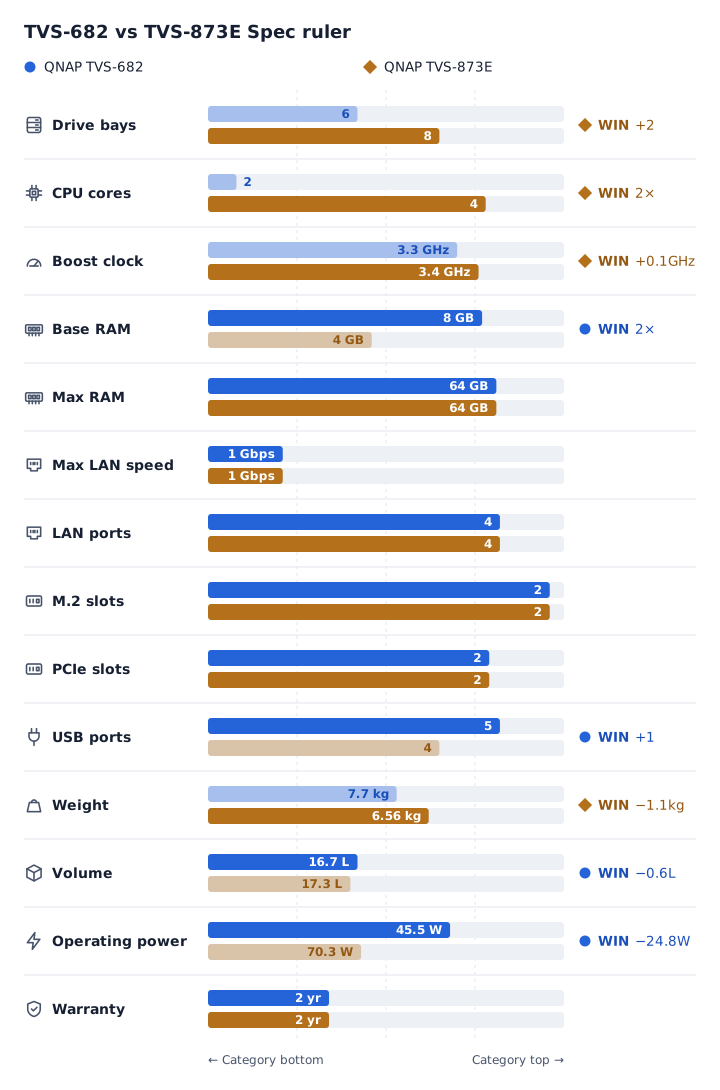
Bottom line. Of the 8 specs that differ, the QNAP TVS-682 leads on 4 (base RAM, USB ports, volume, and 1 more) and the QNAP TVS-873E on 4 (drive bays, CPU cores, boost clock, and 1 more). On our home media server index, the TVS-682 scores 100/100 against 96/100.
Using the 14 specs published on QNAP's official hardware specification pages, here is how the QNAP TVS-682 and QNAP TVS-873E compare. Drive bays: the TVS-873E at 8 bays versus 6 bays for the TVS-682, 2 bays more (1.3x). Among 219 QNAP models, the TVS-873E ranks in the top 35% and the TVS-682 in the bottom 43%. The TVS-873E leads on CPU cores, 4 cores to 2 cores, 2.0x. Among 204 QNAP models, the TVS-873E ranks in the top 22% and the TVS-682 in the bottom 9%. On boost clock, the TVS-873E posts 3.4 GHz and the TVS-682 3.3 GHz, a gap of 0.1 GHz. Among 201 QNAP models, the TVS-873E ranks in the top 24% and the TVS-682 in the top 30%. Base RAM: the TVS-682 at 8 GB versus 4 GB for the TVS-873E, 4 GB higher (2.0x). Among 219 QNAP models, the TVS-682 ranks in the top 23% and the TVS-873E in the bottom 47%.
Key differences 3
CPU coresTVS-873E leads
- TVS-873E 4 cores vs the TVS-682 at 2 cores
- the TVS-873E has 2.0x the CPU cores
- among 204 QNAP models: TVS-873E in the top 22%, TVS-682 in the bottom 9%
4 cores for backups and transcodes at once
Base RAMTVS-682 leads
- TVS-682 8 GB vs the TVS-873E at 4 GB
- the TVS-682 has 2.0x the base RAM
- among 219 QNAP models: TVS-682 in the top 23%, TVS-873E in the bottom 47%
8 GB out of the box for several apps
Operating powerTVS-682 leads
- TVS-682 45.5 W vs the TVS-873E at 70.3 W
- the TVS-682: 24.8 W less power
- among 208 QNAP models: TVS-682 in the top 32%, TVS-873E in the bottom 44%
about 216.9 kWh less per year if left on 24/7
Key specs at a glance
| Spec | TVS-682 | TVS-873E |
|---|---|---|
| CPU cores | 2bottom 9% | 4WINtop 22% |
| Base RAM | 8 GBWINtop 23% | 4 GBbottom 47% |
| Operating power | 45.5 WWINtop 32% | 70.3 Wbottom 44% |
| Drive bays | 6bottom 43% | 8WINtop 35% |
| USB ports | 5WINtop 18% | 4top 35% |
| Weight | 7.7 kgtop 47% | 6.56 kgWINtop 38% |
Show every spec
| Spec | TVS-682 | TVS-873E |
|---|---|---|
| Drive bays | 6bottom 43% | 8WINtop 35% |
| CPU cores | 2bottom 9% | 4WINtop 22% |
| Boost clock | 3.3 GHztop 30% | 3.4 GHzWINtop 24% |
| Base RAM | 8 GBWINtop 23% | 4 GBbottom 47% |
| Max RAM | 64 GBtop 19% | 64 GBtop 19% |
| Max LAN speed | 1 Gbpsbottom 22% | 1 Gbpsbottom 22% |
| LAN ports | 4top 18% | 4top 18% |
| M.2 slots | 2top 4% | 2top 4% |
| PCIe slots | 2top 21% | 2top 21% |
| USB ports | 5WINtop 18% | 4top 35% |
| Weight | 7.7 kgtop 47% | 6.56 kgWINtop 38% |
| Volume | 16.7 LWINbottom 43% | 17.3 Lbottom 41% |
| Operating power | 45.5 WWINtop 32% | 70.3 Wbottom 44% |
| Warranty | 2 yrbottom 35% | 2 yrbottom 35% |
| Metric (0–100) | TVS-682 | TVS-873E |
|---|---|---|
| Performance percentile | 26.3 | 59.9WIN |
| Lightness percentile | 53.1 | 61.8WIN |
| Compactness percentile | 41.7WIN | 39.4 |
| Home media server fit | 100WIN | 96 |
| Small office fit | 66 | 80WIN |
| 10GbE video editing fit | 41 | 48WIN |
| Low-power compact 24/7 fit | 30WIN | 9 |
The details
How to choose
- Base RAM matters most → the TVS-682 (8 GB vs 4 GB)
- CPU cores matters most → the TVS-873E (4 cores vs 2 cores)
More TVS-682 leads
- USB ports: 5 ports vs 4 ports
- Volume: 16.7 L vs 17.3 L
More TVS-873E leads
- Drive bays: 8 bays vs 6 bays
- Weight: 6.56 kg vs 7.7 kg
- Boost clock: 3.4 GHz vs 3.3 GHz
Combined metrics
- Expansion slots in total (M.2 plus PCIe): 4 on both
- Total built-in LAN bandwidth (sum of port speeds): 4 Gbps on both
- Operating power per bay: TVS-682 7.58 W vs 8.78 W
Combined metrics
- Weight per bay: TVS-873E 0.82 kg vs 1.28 kg
- Memory headroom (max minus base): TVS-873E 60 GB vs 56 GB
Same on both
- max RAM 64 GB, max LAN speed 1 Gbps, LAN ports 4
- M.2 slots 2, PCIe slots 2, warranty 2 years
Use-case scores
- Home media server: TVS-682 100 vs 96
- Small-office file server: TVS-873E 80 vs 66
Use-case scores
- 10GbE video editing: TVS-873E 48 vs 41
- Low-power compact 24/7 use: TVS-682 30 vs 9
Use-case scores are Specotomy's own index, computed by fixed rules from official manufacturer specs; they are not manufacturer scores.
FAQ
- Which has more drive bays, the QNAP TVS-682 or the QNAP TVS-873E?
- The TVS-873E, with 8 bays against 6 bays for the TVS-682.
- Which draws less power, the QNAP TVS-682 or the QNAP TVS-873E?
- The TVS-682, with 45.5 W against 70.3 W for the TVS-873E.
- Which is lighter, the QNAP TVS-682 or the QNAP TVS-873E?
- The TVS-873E, with 6.56 kg against 7.7 kg for the TVS-682.
- Which use cases suit the QNAP TVS-682 and the QNAP TVS-873E?
- A home media server: the TVS-682. A small-office file server: the TVS-873E. (based on our own use-case index)