As an Amazon Associate I earn from qualifying purchases. (Also includes AliExpress and Coupang affiliate links; Coupang: 이 포스팅은 쿠팡 파트너스 활동의 일환으로, 이에 따른 일정액의 수수료를 제공받습니다.)
ASUS ExpertCenter PN55 vs ASUS NUC 15 Pro Plus
The quick verdict
- Spec leadeach leads on 2 of 4 differing specs
- Best forExpertCenter PN55 for the smallest possible PC for a tight deskNUC 15 Pro Plus for home-office work across several monitors
Rankings and scores come from the specs alone and are not affected by affiliate commissions.
Spec ruler
In short
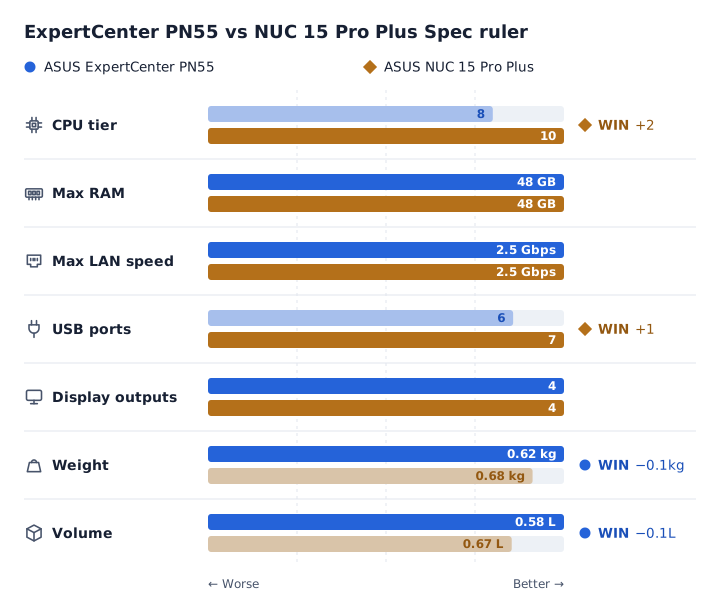
Bottom line. Of the 4 specs that differ, the ASUS ExpertCenter PN55 leads on 2 (weight and volume) and the ASUS NUC 15 Pro Plus on 2 (CPU tier and USB ports). On our home-office work index, the NUC 15 Pro Plus scores 100/100 against 93/100.
Using the 8 specs published on ASUS's official tech spec pages plus our own CPU tier rating, here is how the ASUS ExpertCenter PN55 and ASUS NUC 15 Pro Plus compare. CPU tier: the NUC 15 Pro Plus at 10/10 versus 8/10 for the ExpertCenter PN55, 2/10 higher (1.2x). The NUC 15 Pro Plus leads on USB ports, 7 ports to 6 ports, 1.2x. On weight, the ExpertCenter PN55 posts 0.62 kg and the NUC 15 Pro Plus 0.68 kg, a gap of 0.06 kg. Volume: the ExpertCenter PN55 at 0.58 L versus 0.67 L for the NUC 15 Pro Plus, 0.09 L lower (1.2x). Display outputs per liter: the ExpertCenter PN55 at 6.96 against 5.93 for the NUC 15 Pro Plus. Max RAM per liter: the ExpertCenter PN55 at 83.5 GB against 71.2 GB for the NUC 15 Pro Plus.
Key differences 3
CPU tierNUC 15 Pro Plus leads
- NUC 15 Pro Plus 10/10 vs the ExpertCenter PN55 at 8/10
- the NUC 15 Pro Plus is 1.2x higher
Our CPU tier 10/10: more multitasking headroom
USB portsNUC 15 Pro Plus leads
- NUC 15 Pro Plus 7 ports vs the ExpertCenter PN55 at 6 ports
- the NUC 15 Pro Plus has 1.2x the USB ports
1 more USB for drives or a UPS
VolumeExpertCenter PN55 leads
- ExpertCenter PN55 0.58 L vs the NUC 15 Pro Plus at 0.67 L
- the ExpertCenter PN55: 0.09 L smaller
Key specs at a glance
| Spec | ExpertCenter PN55 | NUC 15 Pro Plus |
|---|---|---|
| CPU tier (our rating, of 10) | 8 | 10WIN |
| Volume | 0.58 LWIN | 0.67 L |
| USB ports | 6 | 7WIN |
| Weight | 0.62 kgWIN | 0.68 kg |
Show every spec
| Spec | ExpertCenter PN55 | NUC 15 Pro Plus |
|---|---|---|
| CPU tier (our rating, of 10) | 8 | 10WIN |
| Max RAM | 48 GB | 48 GB |
| Max LAN speed | 2.5 Gbps | 2.5 Gbps |
| USB ports | 6 | 7WIN |
| Display outputs | 4 | 4 |
| USB4/Thunderbolt | Yes | Yes |
| Wi-Fi | Wi-Fi 7 | Wi-Fi 7 |
| Weight | 0.62 kgWIN | 0.68 kg |
| Volume | 0.58 LWIN | 0.67 L |
| Metric (0–100) | ExpertCenter PN55 | NUC 15 Pro Plus |
|---|---|---|
| Home office fit | 93 | 100WIN |
| Living-room media PC fit | 100 | 100 |
| Homelab fit | 80 | 86WIN |
| Tiny desk setup fit | 56WIN | 49 |
The details
How to choose
- Volume matters most → the ExpertCenter PN55 (0.58 L vs 0.67 L)
- CPU tier matters most → the NUC 15 Pro Plus (10/10 vs 8/10)
More ExpertCenter PN55 leads
- Weight: 0.62 kg vs 0.68 kg
Combined metrics
- Display outputs per liter: ExpertCenter PN55 6.96 vs 5.93
- Max RAM per liter: ExpertCenter PN55 83.5 GB vs 71.2 GB
Same on both
- max RAM 48 GB, max LAN speed 2.5 Gbps, display outputs 4
- USB4/Thunderbolt supported, Wi-Fi generation Wi-Fi 7
Use-case scores
- Home-office work: NUC 15 Pro Plus 100 vs 93
- Homelab or virtualization box: NUC 15 Pro Plus 86 vs 80
- Tiny desk setup: ExpertCenter PN55 56 vs 49
Use-case scores are Specotomy's own index, computed by fixed rules from official manufacturer specs; they are not manufacturer scores.
FAQ
- Which has the higher CPU tier, the ASUS ExpertCenter PN55 or the ASUS NUC 15 Pro Plus?
- The NUC 15 Pro Plus, with 10/10 against 8/10 for the ExpertCenter PN55.
- Which is lighter, the ASUS ExpertCenter PN55 or the ASUS NUC 15 Pro Plus?
- The ExpertCenter PN55, with 0.62 kg against 0.68 kg for the NUC 15 Pro Plus.
- Which use cases suit the ASUS ExpertCenter PN55 and the ASUS NUC 15 Pro Plus?
- Home-office work: the NUC 15 Pro Plus. A homelab or virtualization box: the NUC 15 Pro Plus. A tiny desk setup: the ExpertCenter PN55. (based on our own use-case index)